A 3kW solar system price in India with subsidy is about ₹72,000 to ₹1,02,000 after the ₹78,000 central subsidy, if the installed price is ₹50,000 to ₹60,000 per kW. In Uttar Pradesh, the state subsidy of up to ₹30,000 can bring it down to about ₹42,000 to ₹72,000. Expect roughly 12 units a day from 3 kW.
This guide breaks down where those numbers come from, how many panels and how much roof a 3 kW system needs, how much electricity to expect, and an illustrative payback for a Greater Noida home. ChhatSolar does not sell solar systems or take commissions, so none of the figures below are sales quotes.
Last reviewed: 14 October 2026. Prices and subsidy rules change, so use these as a guide and confirm current amounts on pmsuryaghar.gov.in.
What a 3 kW system costs before subsidy
There is no fixed government price. Under PM Surya Ghar you agree the price directly with a registered vendor. To judge a quote, it helps to know four reference points:
| Reference point | Per kW | 3 kW total | What it is |
|---|---|---|---|
| MNRE benchmark cost | ₹50,000 (first 2 kW), ₹45,000 (3rd kW) | ₹1,45,000 | Used only to calculate the subsidy; not a price cap |
| UPNEDA tentative cost, before GST cut | ₹55,000 | ₹1,65,000 | Printed on UPNEDA’s flyer |
| UPNEDA tentative cost, after GST cut | ₹52,000 | ₹1,56,000 | Same flyer, marked “tentative” |
| Reported market rate (March 2026) | about ₹60,000 | about ₹1,80,000 | Trade press estimate, not UP-specific |
From these, ChhatSolar uses ₹50,000 to ₹60,000 per kW as an indicative range for a standard 3 kW on-grid system with Indian-made (DCR) panels. It is a cited range, not a promise. Quotes can be higher for an elevated structure, a long cable run, premium inverters or extra site work, which the scheme’s sample agreement allows vendors to bill separately.
The GST change also matters. GST on renewable energy devices fell from 12% to 5% from 22 September 2025, and MNRE estimated a typical 3 kW rooftop system would become cheaper by about ₹9,000 to ₹10,500 (PIB, 17 September 2025). In October 2025 UPNEDA wrote to all registered vendors telling them to pass the lower GST on to customers. If a quote looks like it predates the cut, ask about it.
3kW solar system price in India with subsidy: the net cost
The central PM Surya Ghar subsidy for 3 kW is ₹78,000. In UP, UPNEDA adds up to ₹30,000. Here is the net cost at different installed prices:
| Installed price per kW | Price for 3 kW | After central subsidy (₹78,000) | After central + UP subsidy (₹1,08,000) |
|---|---|---|---|
| ₹50,000 | ₹1,50,000 | ₹72,000 | ₹42,000 |
| ₹52,000 | ₹1,56,000 | ₹78,000 | ₹48,000 |
| ₹55,000 | ₹1,65,000 | ₹87,000 | ₹57,000 |
| ₹60,000 | ₹1,80,000 | ₹1,02,000 | ₹72,000 |
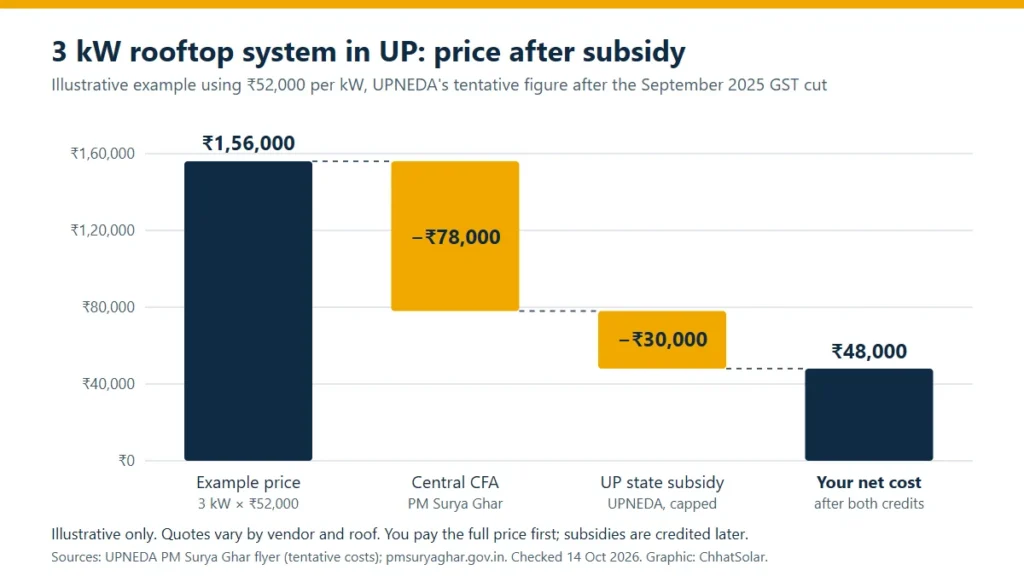
Remember the cash flow: you pay the full price first, and both subsidies are credited later. The details are in our guides to the PM Surya Ghar subsidy and the solar subsidy in UP.
How many solar panels are required for 3kW?
Divide 3,000 watts by the wattage of one panel and round to a whole number. MNRE’s March 2026 sizing advisory uses 540 W panels in its examples, and UPNEDA’s consumer guide shows a 550 W panel label.
| Panel rating | Panels needed | Actual capacity |
|---|---|---|
| 450 W | 7 | 3.15 kW |
| 540 W | 6 | 3.24 kW |
| 550 W | 6 | 3.30 kW |
A little over 3 kW is fine. MNRE’s advisory suggests DISCOMs allow up to 10% extra panel capacity over your sanctioned load, provided the inverter’s AC rating stays within it. The subsidy, though, stops at 3 kW.
Roof space: MNRE says about 10 to 12 sq m of shade-free area is needed per kW, so a 3 kW system needs roughly 30 to 36 sq m, or about 323 to 388 sq ft. Keep it clear of the shadows of water tanks, parapet walls and trees.
3kW solar system unit per day: how much electricity to expect
A “unit” is one kilowatt-hour (kWh), the same unit on your electricity bill. Different official and modelled sources give slightly different numbers, because they measure different things:
| Basis | Units per kW per day | 3 kW per day | 3 kW per year |
|---|---|---|---|
| PIB: “more than 300 units a month” for 3 kW | about 3.3 (minimum) | about 10 | about 3,650 |
| PVWatts model, Noida | 3.95 | about 11.9 | about 4,325 |
| ChhatSolar planning assumption | 4.0 | 12 | 4,380 |
| PVWatts model, Greater Noida | 4.26 | about 12.8 | about 4,665 |
| MNRE FAQ, clear sunny day only | 4 to 5.5 | 12 to 16.5 | not an annual figure |
For planning, ChhatSolar uses 4 units per kW per day, so about 12 units a day or 4,380 a year for 3 kW. Expect less in December and January, and more in March and April. Dust, haze and shade all lower output, which is why cleaning matters (see our solar panel maintenance guide).
Worked example: payback for a Greater Noida home (illustrative)
This is an illustrative calculation with stated assumptions, not a quote or a guarantee:
- An independent house on an NPCL domestic connection using about 450 units a month, with a sanctioned load of 3 kW or more.
- A 3 kW on-grid system generating 4,380 units a year, all of it used to cut the units you buy, because the home uses more than the panels make.
- Each unit saved is valued at ₹6.50, the energy charge in NPCL’s FY 2026-27 tariff schedule for domestic use above 300 units a month. Fixed charges (₹110 per kW per month) do not change with solar, and duty and surcharges are left out.
- Yearly saving: 4,380 × ₹6.50 = ₹28,470.
| Scenario | Net cost | Yearly saving | Simple payback |
|---|---|---|---|
| ₹52,000 per kW, central + UP subsidy | ₹48,000 | ₹28,470 | about 1.7 years |
| ₹60,000 per kW, central + UP subsidy | ₹72,000 | ₹28,470 | about 2.5 years |
| ₹60,000 per kW, central subsidy only | ₹1,02,000 | ₹28,470 | about 3.6 years |
What would make the real payback longer: saved units that fall in cheaper slabs (₹5.50 or ₹6.00), surplus units exported and paid at only ₹2 at year end, loan interest, cleaning costs, and repairs after the vendor’s five-year maintenance period. Panels also lose a little output each year. To test your own bill, use the solar cost calculator.
Ongoing and hidden costs to ask about
- Net meter. MNRE’s sample agreement puts net meter supply, testing and approvals in the vendor’s scope. Ask whether your quote includes it and any DISCOM charges.
- Structure. A standard low structure costs less than a raised one that leaves room underneath.
- Maintenance. Registered vendors must provide five years of free repairs and maintenance. After that, repairs are on you.
- Battery. A 3 kW system with battery costs more, and the battery earns no extra subsidy. Our on-grid vs off-grid guide explains the trade-off.
- Billing. How exported units are credited affects your savings; see net metering in UP.
Key takeaways
- Indicative price: ₹50,000 to ₹60,000 per kW, so ₹1,50,000 to ₹1,80,000 for 3 kW before subsidy.
- After the ₹78,000 central subsidy: ₹72,000 to ₹1,02,000. In UP, after up to ₹1,08,000 total subsidy: ₹42,000 to ₹72,000.
- You need about six 540 to 550 W panels and 30 to 36 sq m of shade-free roof.
- Plan on about 12 units a day (4,380 a year), lower in winter.
- For a home buying 300+ units a month from NPCL, the illustrative payback is under 4 years, and under 2 years at the lower price.
Frequently asked questions
What is the price of a 3kW solar system in India with subsidy?
At an installed price of ₹50,000 to ₹60,000 per kW, a 3 kW system costs ₹1,50,000 to ₹1,80,000 before subsidy and ₹72,000 to ₹1,02,000 after the ₹78,000 central subsidy. In Uttar Pradesh, the state subsidy of up to ₹30,000 can lower it further, to about ₹42,000 to ₹72,000.
How many units does a 3kW solar system generate per day?
Plan on about 12 units a day as a yearly average in Noida and Greater Noida, or about 4,380 units a year. Modelled figures for the area range from about 11.9 to 12.8 units a day, and clear days can produce 12 to 16.5 units.
How many solar panels are required for a 3kW system?
Six panels of 540 W or 550 W give 3.24 to 3.30 kW, or seven 450 W panels give 3.15 kW. Divide 3,000 W by your panel’s wattage and round to a whole number.
How much roof space does a 3 kW solar system need?
About 30 to 36 sq m (roughly 323 to 388 sq ft) of shade-free roof, based on MNRE’s guide of 10 to 12 sq m per kW. Newer high-wattage panels may need slightly less.
Is a 3 kW system enough for a home using 300 to 400 units a month?
Close to it. At 4 units per kW per day, 3 kW makes about 365 units a month on average. The national portal suggests 2 to 3 kW for 150 to 300 units a month and above 3 kW for more than 300. Your sanctioned load also limits the size.
Does a 3 kW system with battery get the same subsidy?
The subsidy is calculated only on panel capacity, so a battery adds nothing to it. Off-grid systems are not eligible at all, and grid-connected battery systems qualify only where the state regulator has approved the arrangement.
Sources: PIB, GST cut on renewable energy devices; UPNEDA flyer with tentative costs; MNRE rooftop solar FAQ; NPCL tariff schedule FY 2026-27; MNRE CFA guidelines; NLR PVWatts model runs. All accessed 14 October 2026.