The PM Surya Ghar subsidy is a one-time central grant for grid-connected rooftop solar on homes: ₹30,000 per kW for the first 2 kW and ₹18,000 for the third kW. That means ₹30,000 for 1 kW, ₹60,000 for 2 kW and a maximum of ₹78,000 for 3 kW or more, paid after your DISCOM inspects the system.
This guide explains the PM Surya Ghar subsidy amount for each system size, who qualifies, how the money is paid and the mistakes that most often hold it up. ChhatSolar is an independent guide, not the official scheme website. You can only apply on the official PM Surya Ghar National Portal.
Last reviewed: 14 October 2026. Scheme figures change, so confirm the current amounts on the official portal before you decide.
What the PM Surya Ghar subsidy is
PM Surya Ghar: Muft Bijli Yojana is the central government’s rooftop solar scheme for households. The Union Cabinet approved it on 29 February 2024 with an outlay of ₹75,021 crore, aiming to put rooftop solar on one crore homes and help each produce up to 300 units of free electricity a month (PIB release, 29 February 2024).
The subsidy itself is officially called Central Financial Assistance (CFA). It is money from the Ministry of New and Renewable Energy (MNRE) that reimburses part of what you pay a vendor. Under the scheme’s guidelines the implementation period runs until 31 March 2027, and the portal shows the same closing date.
Two terms come up again and again:
- kW or kWp (kilowatt peak): the rated power of your solar panels under standard test conditions. A “3 kW system” means panels rated at about 3 kWp in total.
- DISCOM: your electricity distribution company. In Greater Noida that is usually NPCL; in Noida it is usually PVVNL. Your electricity bill shows which one you have.
PM Surya Ghar subsidy amount by system size
The CFA is set at 60% of MNRE’s benchmark cost for the first 2 kW and 40% of the benchmark cost for the third kW. With the benchmark fixed at ₹50,000 per kW for the first 2 kW and ₹45,000 for the next kW, that works out to ₹30,000 and ₹18,000 per kW. Above 3 kW there is no additional central subsidy.
| System size | Central subsidy (CFA) | How it is worked out |
|---|---|---|
| 1 kW | ₹30,000 | 1 × ₹30,000 |
| 1.5 kW | ₹45,000 | 1.5 × ₹30,000 |
| 2 kW | ₹60,000 | 2 × ₹30,000 |
| 2.5 kW | ₹69,000 | ₹60,000 + 0.5 × ₹18,000 |
| 3 kW | ₹78,000 | ₹60,000 + ₹18,000 |
| 5 kW or 10 kW | ₹78,000 | Capped at the 3 kW amount |
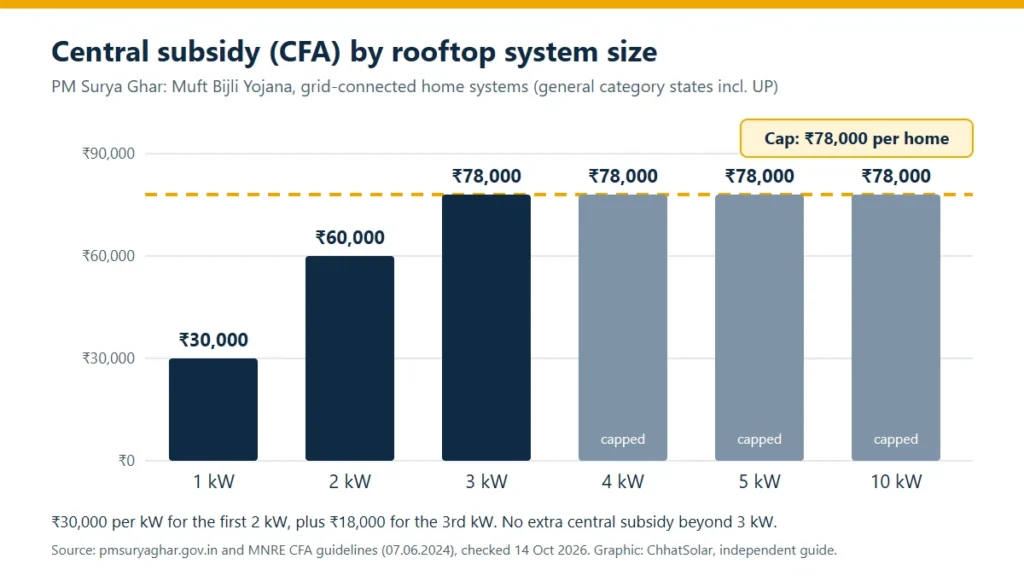
A few details matter when you compare quotes:
- Panels decide the amount, not the inverter. The CFA follows the rated DC capacity of the modules. A bigger or smaller inverter does not change it.
- Batteries add nothing. You may add a battery or other components, but the subsidy is still calculated only on panel capacity.
- UP is not a special category state. Hill and North-East states get about 10% more per kW. Homes in Uttar Pradesh get the standard rates above.
In Uttar Pradesh there is also a separate state top-up of up to ₹30,000, which is paid by UPNEDA. It is explained in our guide to the solar subsidy in UP.
Housing societies and RWAs
Group Housing Societies and Resident Welfare Associations can claim ₹18,000 per kW for solar that powers common facilities, including EV charging. The limit is 3 kW per house, up to 500 kW in total, and it includes any systems that residents have already installed on their own. MNRE’s example: an RWA with 20 houses that installs 100 kW is eligible for CFA on 60 kW, which is ₹10,80,000; with 50 houses the same 100 kW earns ₹18,00,000. The connection used must serve only common areas. If your society is considering this, ask your DISCOM early which metering arrangement it will approve.
Who is eligible for the solar panel for home government subsidy
The portal accepts only residential consumers and RWAs. To qualify for the solar panel for home government subsidy, your installation must meet all of these conditions set out in the scheme guidelines:
- You have your own residential electricity connection and a valid DISCOM consumer number.
- The system is grid-connected and tied to that residential connection. Off-grid systems are not eligible.
- It sits on a roof, terrace, balcony or elevated structure.
- The panels meet the Domestic Content Requirement (DCR), meaning modules made in India from Indian-made cells.
- A vendor registered on the National Portal installs it.
- The system has not received CFA before. A system moved from another site does not qualify again.
If you already have a subsidised system and want to expand it, you can claim only for the balance up to 3 kW. For example, a home with 1 kW that grows to 4 kW can claim for 2 more kW, which is ₹48,000. Households that do not want the subsidy can choose the portal’s “Give It Up” option, and can change their mind until the subsidy is redeemed.
How and when the money reaches you
The scheme works in what the guidelines call capex mode: you pay the vendor yourself, from savings or a loan, and the subsidy is reimbursed later. Here is the sequence.
- When you submit your application, the portal creates an e-token on your profile.
- After installation, the DISCOM physically inspects the system and fits or approves the net meter.
- The e-token is then activated with the CFA for the capacity actually installed.
- You log in and redeem it, after adding bank details. The name on the bank account must match the name on your electricity bill.
- The CFA is paid into your bank account. If you took a loan through the portal, it goes to the loan account first.
The guidelines say claims will be processed within 15 days of DISCOM approval. Treat that as a target rather than a promise. One recent rule is worth knowing: since 3 September 2026, applications with a “confidence score” below 70% are not redeemed directly. Those consumers must upload a signed undertaking and a government name proof such as Aadhaar or a Voter ID.
What “muft bijli” really means
“Muft bijli” means free electricity from your own roof, not a free installation. The free units come from what your panels generate. PIB says a 3 kW system can produce more than 300 units a month on average, which can cover most or all of the energy charges for many homes. You still pay your DISCOM’s fixed charges, and you still pay for any units you draw from the grid beyond what you generate. Our guide to net metering in UP explains how those units are settled on the bill.
Worked example: a Greater Noida family (illustrative)
This is an illustrative calculation, not a quote. Assumptions:
- An independent house in Greater Noida with an NPCL domestic connection and a sanctioned load of at least 3 kW.
- A 3 kW on-grid system with DCR panels, installed by a registered vendor.
- A price of ₹1,56,000, which is UPNEDA’s tentative figure for 3 kW after the September 2025 GST cut. Real quotes vary.
| Item | Amount |
|---|---|
| Price paid to the vendor | ₹1,56,000 |
| PM Surya Ghar subsidy (CFA) | − ₹78,000 |
| Cost after central subsidy | ₹78,000 |
| UP state subsidy, if still available when you apply | − ₹30,000 |
| Net cost after both | ₹48,000 |
If the same family installed 5 kW instead, the central subsidy would stay at ₹78,000. Bigger systems can still make sense for homes that use a lot of power, but the extra kilowatts are paid for in full. To see how price, size and savings interact, try the solar cost calculator or read the full 3 kW system price breakdown.
Mistakes that delay or cancel the subsidy
- Non-DCR panels. Using imported cells or modules anywhere in the system makes it ineligible.
- An unregistered or deactivated vendor. Check the vendor on the portal’s registered list before you sign, and look at the portal’s list of deactivated vendors too.
- Name mismatch. If your bank account and electricity bill show different names, fix one of them before you redeem.
- A system larger than your sanctioned load. DISCOMs can return net metering applications that exceed what your connection allows. Raise your sanctioned load first if you need to.
- Letting someone else run your login. A vendor can fill the form for you, but only after you accept that in your own account. Keep the OTP and the final approvals with you.
The full sequence, from registration to redemption, is in our step-by-step guide on how to apply for PM Surya Ghar.
Key takeaways
- The PM Surya Ghar subsidy is ₹30,000 per kW for the first 2 kW plus ₹18,000 for the third kW, capped at ₹78,000 per home.
- It is based on panel capacity, applies only to grid-connected homes, and needs Indian-made (DCR) panels and a registered vendor.
- You pay the full price first. The subsidy arrives after DISCOM inspection and online redemption.
- RWAs can claim ₹18,000 per kW for common facilities, at up to 3 kW per house and 500 kW in total.
- The scheme runs until 31 March 2027 unless it is extended. Apply only on pmsuryaghar.gov.in.
Frequently asked questions
How much is the PM Surya Ghar subsidy for a 3 kW system?
₹78,000. That is ₹30,000 per kW for the first 2 kW (₹60,000) plus ₹18,000 for the third kW. In Uttar Pradesh you may also get a separate state subsidy of up to ₹30,000 from UPNEDA.
Do I get more subsidy for a 5 kW or 10 kW system?
No. The central subsidy is capped at ₹78,000 for any home system of 3 kW or more. You can install a larger system, but the capacity above 3 kW gets no extra central subsidy.
Can I get the subsidy if I live in a flat?
Individually, only if you have your own residential electricity connection and a roof, terrace or balcony where the system can legally be installed. Otherwise your RWA or housing society can apply for ₹18,000 per kW for solar that powers common facilities.
What is the last date to apply for PM Surya Ghar?
The guidelines set the implementation period until 31 March 2027, and the portal shows the scheme closing on that date. Check the portal for any extension before you plan around it.
How do I check my PM Surya Ghar subsidy status?
Log in on pmsuryaghar.gov.in with your registered mobile number and the OTP. Your application shows its current stage, and once the DISCOM has inspected the system, the activated subsidy amount appears for redemption. The portal’s toll-free number is 15555.
Is the subsidy available for off-grid or battery systems?
Off-grid systems are not eligible. Grid-connected systems with batteries can be eligible if the state electricity regulator approves the arrangement, but the subsidy is still calculated only on panel capacity.
Sources: PM Surya Ghar National Portal (subsidy structure, closing date, notices); MNRE guidelines for CFA to residential consumers; portal FAQs; PIB, 29 February 2024. All accessed 14 October 2026.