Net metering in UP lets a solar home use its own power first, send surplus units to the grid through a two-way meter, and pay only for the net units it takes. Under UPERC rules, NPCL and PVVNL domestic consumers get net metering, and credit left at the end of the financial year is paid at ₹2 per unit.
This guide explains net metering in plain words, who is eligible in Uttar Pradesh, how your bill is settled, how net metering differs from net billing, and what to expect from NPCL in Greater Noida and PVVNL in Noida. ChhatSolar is an independent guide and is not connected to either DISCOM or to the regulator.
Last reviewed: 14 October 2026. Regulations and DISCOM procedures change, so confirm the current rules with your DISCOM before you install.
Net metering meaning, in plain words
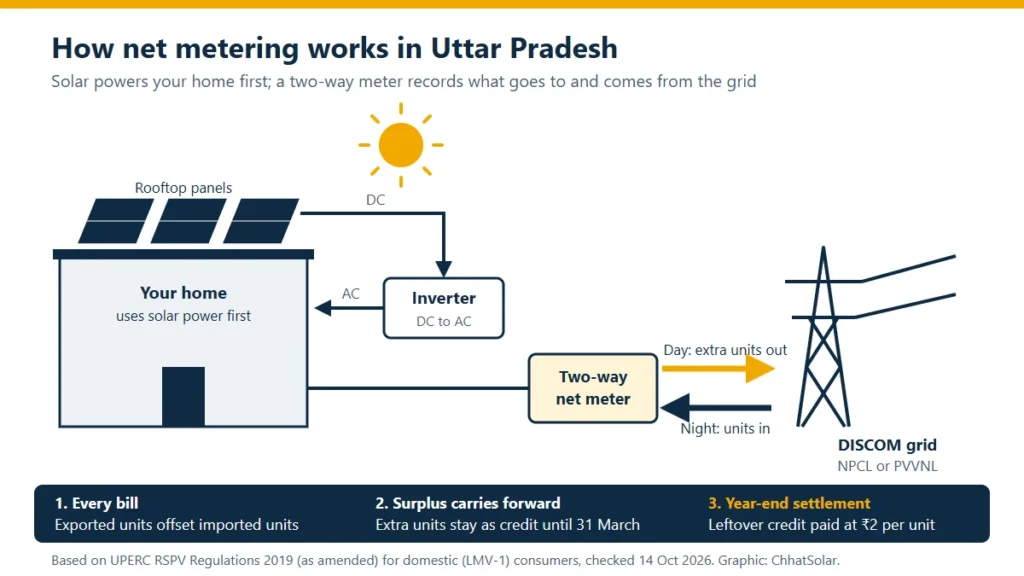
Your solar panels make power only in daylight. With net metering, that power runs your home first. When the panels make more than you are using, say at noon on a sunny day, the extra flows out to the grid. At night, or on cloudy days, you draw power from the grid as usual.
A single bi-directional meter (often just called a net meter) records both flows. In MNRE’s words, at the end of the billing period the net energy used is worked out and you pay only for that (MNRE rooftop solar FAQ). Someone who both consumes and produces electricity like this is sometimes called a prosumer.
Who gets net metering in UP
The rules come from the Uttar Pradesh Electricity Regulatory Commission’s Rooftop Solar PV Grid Interactive System Gross/Net Metering Regulations, 2019 (the “RSPV Regulations”), as amended. They apply to every DISCOM in the state, including NPCL and PVVNL.
- Net metering is for domestic consumers (tariff category LMV-1) and metered agricultural consumers (LMV-5). The Second Amendment of November 2023 extended it to public institutions and to private schools, colleges and research institutes.
- Net billing (also called net feed-in) is open to any consumer category, under the First Amendment of June 2022.
- Gross metering, where all generation is exported and paid for, is a third option.
- You can use only one of these three arrangements in the same premises.
Size limits. Your system must be at least 1 kWp and cannot exceed 100% of your connected or contracted load (the regulations allow up to 2 MWp, which is far beyond any home). NPCL gives the example that a 5 kW sanctioned load allows up to 5 kWp. For PM Surya Ghar homes, MNRE’s March 2026 advisory suggests DISCOMs allow up to 10% extra panel capacity, as long as the inverter stays within the sanctioned load. DISCOMs also check how much solar the local distribution transformer can take.
How your bill is settled under net metering in UP
Regulation 10.4 of the RSPV Regulations sets out the settlement. In everyday terms:
- Every bill shows the units your system exported, the units the DISCOM supplied, the net units billed and any credit carried forward.
- If you export more than you import in a billing period, the extra units become a credit that offsets your consumption in later bills.
- If you import more, you pay for the net units after using up any credit.
- Time-of-day billing: if your connection is billed on time-of-day rates, units are matched within the same time block (peak with peak, and so on).
- Credits offset units only. They cannot be used against fixed charges or other fees.
- Year-end settlement: the settlement period runs from 1 April to 31 March. Any credit still unused on 31 March is paid at ₹2 per unit, and the credit then resets to zero for the new year. If you leave the arrangement, unused credit is also paid at ₹2 per unit.
That ₹2 rate is far below what you pay for grid power, so the best result comes from a system that roughly matches your own yearly use, rather than one that produces a large surplus.
Net metering vs net billing
| Net metering (UP) | Net billing / net feed-in (UP) | |
|---|---|---|
| Meter | One two-way meter | One two-way meter |
| How exports are counted | In units, offset against units you import | In rupees, at a separate feed-in tariff |
| Value of an exported unit | Same as a unit you would otherwise buy, until 31 March; then ₹2 | The feed-in tariff, which UPERC sets equal to the gross metering tariff |
| Surplus | Carried forward as units within the financial year | Carried forward as money; any balance paid at year end |
| Who can use it | Domestic, agricultural, specified institutions | Any category |
| Best suited to | Homes sized to their own use | Commercial and other non-domestic premises |
For a typical home, net metering is simpler and usually worth more, because each exported unit cancels a unit you would otherwise pay full retail price for.
NPCL net metering in Greater Noida
NPCL (Noida Power Company Limited) supplies electricity across about 335 sq km of Greater Noida. Its rooftop solar page confirms that domestic and agricultural consumers are eligible for net metering, that all categories can use net billing, and that unadjusted credits are paid at ₹2 per unit at the end of the financial year. Useful details from that page:
- Subsidy projects start on the national portal; non-subsidy projects submit documents directly to NPCL.
- Contact: [email protected], 0120 6226606 (10 am to 5 pm, Monday to Friday).
- Office: NPCL 33/11 kV Sub-station, Knowledge Park-III, Greater Noida 201310.
- Scale: NPCL reported 31.332 MW of net-metered rooftop solar as on 31 March 2024.
Parts of NPCL’s page still describe the older Phase-II process and the old solarrooftop.gov.in portal. For subsidised home systems, the current route is the PM Surya Ghar National Portal; our guide on how to apply for PM Surya Ghar covers it.
PVVNL net metering in Noida
Most of Noida is supplied by PVVNL (Pashchimanchal Vidyut Vitran Nigam Ltd), one of the UP Power Corporation’s DISCOMs, which lists Gautam Buddha Nagar among its districts. The same UPERC rules apply, including the ₹2 year-end rate. Apply through the national portal and select PVVNL as your DISCOM. If you are not sure which DISCOM supplies you, the name is printed on your electricity bill.
Getting a net meter fitted
Under PM Surya Ghar, the DISCOM inspects your system after installation, signs the metering agreement with you and installs or approves the net meter. MNRE’s guidelines say that where smart-meter projects have been awarded under the national distribution reform scheme, DISCOMs should fit smart meters for net metering through that programme. MNRE’s sample vendor agreement also places net meter supply, testing and approvals in the vendor’s scope, so ask your vendor what their quote includes. The UP state subsidy is paid only to net-metered homes, so do not skip this step.
Worked example: one year of net metering (illustrative)
An illustrative calculation using ChhatSolar’s planning figure of 4 units per kW per day, so a 3 kW system makes about 4,380 units a year:
| Home A: uses 450 units a month | Home B: uses 200 units a month | |
|---|---|---|
| Yearly use | 5,400 units | 2,400 units |
| Yearly solar generation (3 kW) | 4,380 units | 4,380 units |
| Net position on 31 March | Bought 1,020 units from the grid | 1,980 units of unused credit |
| Year-end payout | None | 1,980 × ₹2 = ₹3,960 |
Home A gets full value from every solar unit. Home B has paid for capacity it cannot use: those 1,980 surplus units earn only ₹3,960, whereas the same units would have been worth ₹10,890 even at NPCL’s lowest domestic energy charge of ₹5.50. A system of about 1.5 to 2 kW would have suited Home B better and cost less. Our 3 kW price guide and the solar cost calculator help you size against your own bills, and the on-grid vs off-grid guide explains why net metering needs a grid-connected system.
Key takeaways
- In UP, domestic (LMV-1) consumers of NPCL and PVVNL are eligible for net metering under UPERC’s RSPV Regulations 2019.
- Exported units offset imported units bill by bill; surplus carries forward until 31 March.
- Unused credit on 31 March is paid at only ₹2 per unit, so size your system to your yearly use.
- Your system cannot exceed your sanctioned load, apart from the small panel tolerance in MNRE’s advisory.
- Net billing values exports in rupees at a feed-in tariff and is mainly for non-domestic consumers.
Frequently asked questions
What is net metering in UP?
It is a billing arrangement under UPERC’s RSPV Regulations 2019 in which a two-way meter records the solar units you export and the units you import. You pay only for the net units. Domestic and agricultural consumers, and some institutions, are eligible.
What rate does NPCL pay for extra solar units?
Under net metering, surplus units first count as credit against your future consumption. Any credit still unused at the end of the financial year (31 March) is paid at ₹2 per unit, as set by UPERC and stated on NPCL’s rooftop solar page.
What is the difference between net metering and net billing?
Net metering offsets exported units against imported units one for one. Net billing values exported units in rupees at a separate feed-in tariff and imported units at your normal tariff. In UP, homes use net metering, while net billing is open to every category.
Can I install a solar system larger than my sanctioned load?
Not under UP’s rules, which cap rooftop capacity at 100% of your connected or contracted load. MNRE’s March 2026 advisory suggests DISCOMs allow up to 10% extra panel capacity if the inverter stays within the sanctioned load. For anything bigger, apply to raise your sanctioned load first.
Do I lose my solar credits every month?
No. Unused credits carry forward from bill to bill until the end of the financial year. On 31 March any remaining credit is paid at ₹2 per unit and the balance resets to zero.
Will my DISCOM fit a smart meter for net metering?
Possibly. MNRE’s guidelines say that in areas where smart-meter projects have been awarded under the national distribution reform scheme, DISCOMs should install smart meters for net metering through that programme. Ask NPCL or PVVNL which meter they will fit.
Sources: UPERC RSPV Regulations, Second Amendment (2023); UPERC RSPV Regulations, First Amendment (2022); UPERC RSPV Regulations 2019 (regs 2(cc), 5.1, 10.4); NPCL rooftop solar page; PVVNL; MNRE rooftop solar FAQ. All accessed 14 October 2026.