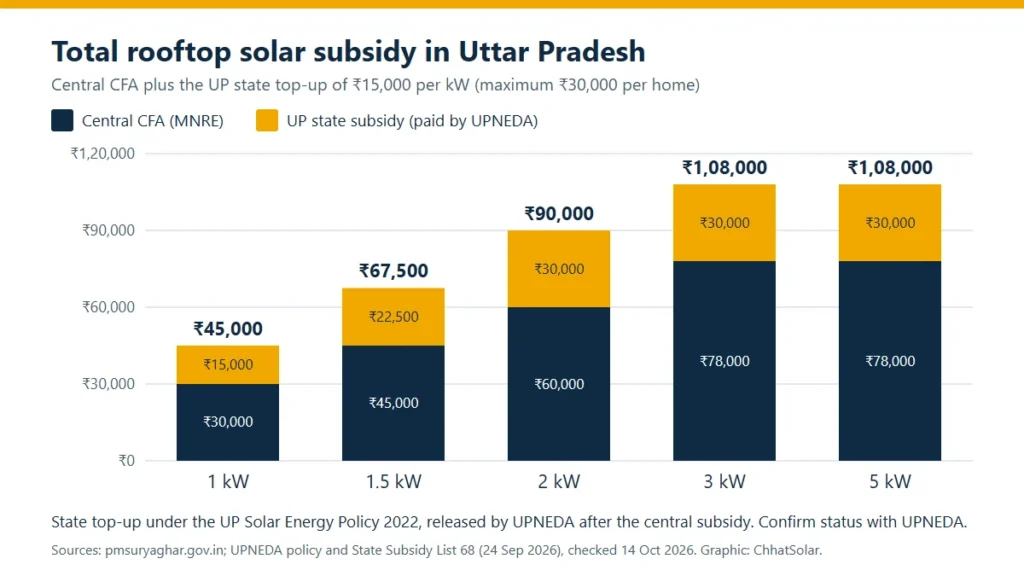
The solar subsidy in UP comes in two parts for homes: up to ₹78,000 from the central PM Surya Ghar scheme, plus a Uttar Pradesh state top-up of ₹15,000 per kW, capped at ₹30,000. Together that is ₹1,08,000 for a 3 kW system. UPNEDA pays the state part after the central subsidy, and only for net-metered homes.
Below you will find the combined amounts by system size, what we found about whether the state subsidy is still being paid in 2026, how UPNEDA releases it, and a worked example for a Greater Noida home. ChhatSolar is an independent guide with no link to UPNEDA or any DISCOM.
Last reviewed: 14 October 2026. Subsidy rules change, so confirm the current position with UPNEDA and on the official portal before you rely on these figures.
The two layers of rooftop solar subsidy in UP
1. Central Financial Assistance (CFA). This comes from the Ministry of New and Renewable Energy under PM Surya Ghar: Muft Bijli Yojana. It is ₹30,000 per kW for the first 2 kW and ₹18,000 for the third kW, with a cap of ₹78,000. It is the same in every general category state. Our guide to the PM Surya Ghar subsidy covers it in detail.
2. The UP state subsidy. The Uttar Pradesh Solar Energy Policy 2022 says the state will give ₹15,000 per kW, up to a maximum of ₹30,000 per consumer, for grid-connected rooftop systems under net metering in the private residential sector. The policy states that this is in addition to the central assistance. It is handled by UPNEDA, the Uttar Pradesh New and Renewable Energy Development Agency, which is the state’s nodal agency for solar.
Because the state amount stops at ₹30,000, it reaches its ceiling at 2 kW. Anything above 2 kW adds nothing more at the state level, and anything above 3 kW adds nothing at either level.
| System size | Central CFA | UP state subsidy | Total subsidy |
|---|---|---|---|
| 1 kW | ₹30,000 | ₹15,000 | ₹45,000 |
| 1.5 kW | ₹45,000 | ₹22,500 | ₹67,500 |
| 2 kW | ₹60,000 | ₹30,000 | ₹90,000 |
| 3 kW | ₹78,000 | ₹30,000 | ₹1,08,000 |
| 5 kW | ₹78,000 | ₹30,000 | ₹1,08,000 |
Is the UP state subsidy still active in 2026?
As far as we could verify, yes, it was still being paid in late 2026. UPNEDA’s solar rooftop portal publishes numbered “State Subsidy List” notices. The latest one on its What’s New page on our review date was List 68, dated 24 September 2026. Earlier lists in 2026 appeared every few weeks from February to early September.
We opened List 68 to check the amounts. Homes with 2 kW or more were shown with ₹30,000, and smaller systems were shown with ₹15,000 per kW (for example, ₹24,750 for 1.65 kW). The list includes consumers in Gautam Buddh Nagar district, which covers both Noida and Greater Noida.
What we could not confirm is how long it will continue. The policy says it stays in force for five years from its issue in 2022, or until the state notifies a new policy, whichever comes first. We found no separate published end date for the subsidy itself. If you are applying now, call the UPNEDA helpline on 1800 1800 005 (the number printed on its PM Surya Ghar flyers) and ask whether your application will be covered.
How the UP state subsidy is paid
UPNEDA’s own note, “How to Avail State Subsidy”, says that after the central subsidy is paid through the National Portal, and once UPNEDA receives the CFA release list from MNRE and REC, it releases the state subsidy to all eligible consumers. In practice that means:
- No separate application is described. UPNEDA’s note does not mention a separate state application, which suggests eligible homes are picked up from the central release list. Keep your documents ready anyway in case UPNEDA asks for them.
- It comes after the central subsidy. Plan your cash flow for two credits, not one.
- Net metering is a condition. The policy ties the state subsidy to grid-connected systems commissioned with net metering. A home on a different arrangement may not qualify. Our guide to net metering in UP explains the rules.
- Bank details matter. Keep the bank account you used for the central subsidy active, with the name matching your electricity bill.
Solar subsidy in UP for 3kW: worked example (illustrative)
This is an illustrative calculation with stated assumptions, not a quote:
- An independent house in Greater Noida, supplied by NPCL, with a sanctioned load of 3 kW or more.
- A 3 kW on-grid system with Indian-made (DCR) panels from a vendor registered on the national portal.
- A price of ₹1,56,000, which is the tentative 3 kW cost UPNEDA printed on its flyer after the September 2025 GST cut. At ₹60,000 per kW, which is closer to some market quotes, the price would be ₹1,80,000.
| Step | At ₹52,000 per kW | At ₹60,000 per kW |
|---|---|---|
| You pay the vendor | ₹1,56,000 | ₹1,80,000 |
| Central CFA credited after DISCOM inspection | − ₹78,000 | − ₹78,000 |
| UP state subsidy credited later by UPNEDA | − ₹30,000 | − ₹30,000 |
| Your net cost | ₹48,000 | ₹72,000 |
The order matters. You need the full ₹1,56,000 or ₹1,80,000 upfront, or a loan, because both subsidies are reimbursements. For the full cost picture, including generation and payback, see our 3 kW solar system price guide, or put your own numbers into the solar cost calculator.
Who qualifies in Noida and Greater Noida
The state subsidy applies across Uttar Pradesh, whichever DISCOM you are with. UPNEDA’s district list places Gautam Buddh Nagar under both PVVNL and NPCL, and NPCL’s own rooftop solar page repeats the ₹15,000 per kW, ₹30,000 maximum rule.
- Independent houses and villas with their own domestic connection are the clearest case.
- Flat owners qualify individually only with their own connection and a roof or balcony space where installation is allowed.
- RWAs and housing societies can get the central ₹18,000 per kW for common-area solar. The state policy text speaks of a subsidy “per consumer” in the private residential sector, and we could not confirm whether an RWA’s common-area connection counts. Ask UPNEDA before you budget for it.
What can go wrong
- Missing the central subsidy. Because the state amount follows the central release list, anything that holds up the CFA holds up the state money too. That includes non-DCR panels, an unregistered vendor or a name mismatch.
- Choosing a blacklisted vendor. UPNEDA’s portal publishes blacklisting notices. Check them, and the national portal’s list of deactivated vendors, before you sign.
- Assuming an amount that has changed. The state subsidy is policy-based and could be revised. This page reflects what was published up to 14 October 2026.
Ready to start? Our step-by-step guide on how to apply for PM Surya Ghar walks through every stage on the portal.
Key takeaways
- UP homes can get the central CFA (up to ₹78,000) plus a state subsidy of ₹15,000 per kW, capped at ₹30,000.
- The combined maximum is ₹1,08,000, reached at 3 kW. The state part maxes out at 2 kW.
- UPNEDA pays the state subsidy after the central CFA, using the central release list, and only for net-metered systems.
- UPNEDA was still publishing state subsidy payment lists in September 2026, but no end date has been announced. Confirm with UPNEDA before you apply.
Frequently asked questions
How much solar subsidy is available in UP for a 3 kW system?
Up to ₹1,08,000: ₹78,000 central CFA under PM Surya Ghar plus ₹30,000 from the UP state subsidy. Both are paid after the system is installed, inspected and commissioned with net metering.
Is the UP state solar subsidy still available in 2026?
UPNEDA was still publishing state subsidy payment lists in 2026; the latest we found was List 68, dated 24 September 2026. No end date for the subsidy has been announced, so confirm with UPNEDA that your application will be covered.
Do I need to apply separately for the UPNEDA state subsidy?
UPNEDA says it releases the state subsidy to eligible consumers once it receives the central subsidy release list from MNRE and REC, and it does not describe a separate application. Keep your installation and bank documents ready in case UPNEDA asks for them.
What is the solar subsidy in UP for a 2 kW system?
₹90,000 in total: ₹60,000 central CFA plus ₹30,000 state subsidy. Because the state subsidy reaches its ₹30,000 cap at 2 kW, a 2 kW system gets the full state amount.
What is the last date for the solar subsidy in UP?
The central scheme runs until 31 March 2027. The state subsidy comes from the UP Solar Energy Policy 2022, which lasts five years from its issue or until a new policy is notified. We found no separate end date for the state subsidy.
Does the UP subsidy apply to both Noida (PVVNL) and Greater Noida (NPCL)?
Yes. It is a state-wide subsidy for net-metered homes. UPNEDA’s district list covers Gautam Buddh Nagar under both PVVNL and NPCL, and NPCL’s rooftop solar page states the same subsidy.
Sources: UP Solar Energy Policy 2022; UPNEDA solar rooftop portal, What’s New; UPNEDA, How to Avail State Subsidy; UPNEDA PM Surya Ghar page. All accessed 14 October 2026.