Solar panel maintenance cost is low for a home system. Under PM Surya Ghar, your registered vendor must give five years of free repairs and maintenance, so in that period your main ongoing cost is cleaning. UPNEDA advises cleaning every 14 days, and after any dust storm, with soft water and a soft cloth. Most families can do this themselves.
This guide covers what upkeep a rooftop system needs, who pays for what in the first five years and after, how to clean panels safely, an explained estimate of cleaning costs, and a simple checklist. ChhatSolar is an independent guide and does not offer cleaning or maintenance services.
Last reviewed: 14 October 2026. Scheme terms can change, so check your own vendor agreement and the official guidelines for the rules that apply to you.
What maintenance a rooftop solar system needs
A grid-connected home system has no moving parts and no fuel. The upkeep falls into four areas:
- Panels: keeping the glass clean and free of shade, and spotting cracks or damage.
- Inverter: keeping it ventilated and out of enclosed boxes, and watching for error messages.
- Wiring, earthing and lightning protection: checking that cables, connectors and earthing are intact.
- Monitoring: tracking generation on the inverter’s app so you notice problems early.
NCR’s dust, construction activity and winter haze make cleaning the job you will do most often.
Solar panel maintenance cost in the first five years
If you install under PM Surya Ghar, MNRE’s guidelines require registered vendors to repair and maintain the system free of cost for five years from commissioning, under a Comprehensive Maintenance Contract. Components that fail or under-perform in that time must be repaired or replaced free. The scheme’s sample vendor agreement adds that:
- the whole system is warranted for five years from DISCOM commissioning;
- the vendor handles five years of comprehensive operation and maintenance, including overhauls, wear and tear and regular health checks;
- the plant’s performance ratio (actual output compared with what the sunshine should produce) must be at least 75% at commissioning and be kept up for the five years;
- the vendor must show you how to clean the panels, and you provide the water for cleaning.
So for years one to five, expect to spend on cleaning only, plus anything your own agreement excludes. Read the agreement before you approve it on the portal; our guide on how to apply for PM Surya Ghar shows where that step comes.
After year five: costs that can come up
| Item | Years 1 to 5 (PM Surya Ghar) | After year 5 | What to check |
|---|---|---|---|
| Cleaning | You (DIY or paid help) | You | See the estimate below |
| Repairs and faulty parts | Vendor, free under the maintenance contract | You, unless a maker’s warranty applies | Keep every warranty card |
| Panel output | Covered by the 5-year system warranty | Maker’s performance warranty | Scheme specs require over 90% of rated output for 10 years and over 80% for the next 15 |
| Inverter | Vendor, free | Maker’s warranty, then you | Note the inverter’s warranty period on the datasheet |
| Optional maintenance contract | Not needed | Your choice | Ask for a written scope and price |
We have not found a reliable public source for typical inverter replacement costs in India, so we do not quote one. Ask your vendor for the inverter maker’s warranty and for an indicative replacement price when you buy.
Solar panel cleaning: how to do it safely
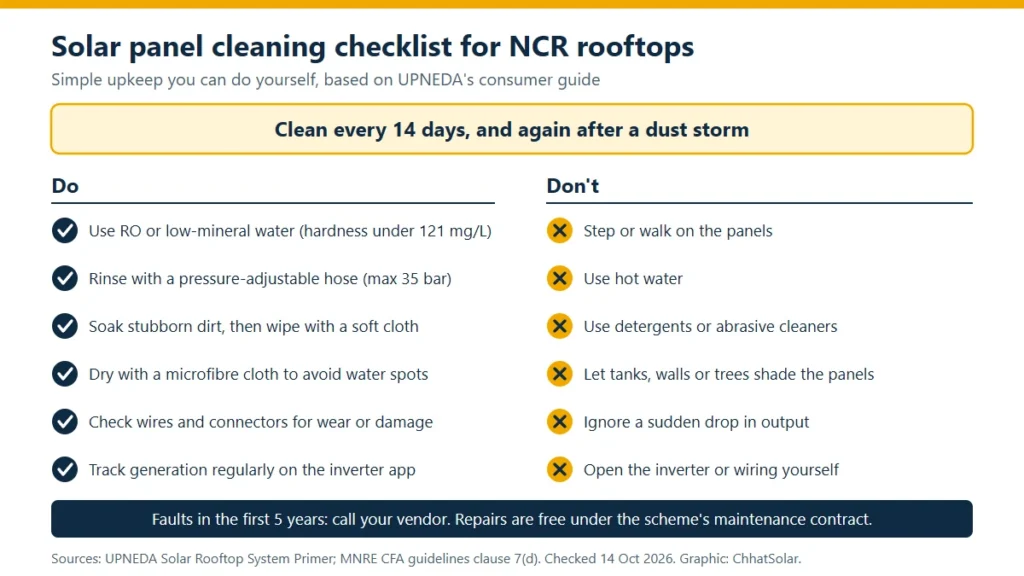
UPNEDA’s Solar Rooftop System Primer, a consumer guide published by the state agency, gives clear cleaning advice:
- Make sure you can reach the panels safely without stepping on them.
- Use RO water or low-mineral tap water, with hardness under 121 mg/L, so minerals do not leave spots.
- Avoid hot water, detergents and abrasive cleaners; room-temperature water is the guidance.
- Rinse with a pressure-adjustable hose, at no more than 35 bar.
- For stubborn dirt or bird droppings, soak the area and wipe gently with a soft cloth.
- Dry with a microfibre cloth to prevent water spots.
- Repeat every 14 days, and after dust storms.
UPNEDA also suggests a simple cleaning kit with a hose pipe, a filter and microfibre cloths. Keep away from the parapet edge, and never open the inverter or junction boxes yourself.
How much does cleaning cost? An explained estimate
There is no official or published market rate for panel cleaning in Noida or Greater Noida, so the figures below are an explained estimate, not market data.
- Visits per year: cleaning every 14 days, as UPNEDA advises, means about 26 cleanings a year (365 ÷ 14).
- Doing it yourself: the cost is mainly water and a few cloths, plus about the time it takes you.
- Paying a helper: multiply 26 by the fee you are quoted. For illustration only, if the fee were ₹100 a visit, that is ₹2,600 a year; at an assumed ₹200 a visit, ₹5,200 a year. These per-visit fees are assumptions, not survey figures.
Over five years, that assumed range adds up to ₹13,000 to ₹26,000 if you pay for every cleaning. Compare that with the illustrative saving of about ₹28,470 a year for a 3 kW system in our 3 kW price guide: cleaning costs are small next to the value of the units clean panels produce.
Solar panel maintenance checklist
| How often | Task | Basis |
|---|---|---|
| Every 14 days, and after dust storms | Clean the panels as described above | UPNEDA primer |
| Regularly (a quick daily glance is easy) | Check generation on the inverter’s monitoring app | UPNEDA primer |
| Periodically | Inspect wires and connectors for wear or damage; note and report issues | UPNEDA primer |
| Periodically | Make sure the inverter area stays ventilated and is not boxed in | UPNEDA primer |
| Whenever something new is built nearby | Check for new shade from water tanks, walls or trees | UPNEDA primer |
| Monthly | Compare your bill’s exported and imported units with the previous month | Good practice under net metering |
| Before year 5 ends | Ask the vendor for a final health check and note open issues while repairs are free | Five-year maintenance contract |
When output drops: what to check before calling the vendor
It helps to know what normal looks like. Modelled output for Greater Noida (NLR PVWatts, south-facing at 25° tilt, 14% losses) shows clear seasonal swings for a 3 kW system:
| Month | Modelled units per day, 3 kW | Month | Modelled units per day, 3 kW |
|---|---|---|---|
| January | 11.1 | July | 11.9 |
| February | 12.3 | August | 12.2 |
| March | 14.7 | September | 13.2 |
| April | 14.4 | October | 13.1 |
| May | 14.0 | November | 11.7 |
| June | 13.0 | December | 11.6 |
If your output falls well below the usual level for the season, check in this order: is the glass dirty, is there new shade, is the inverter showing an error, and was there a grid outage (an on-grid inverter stops when the grid fails; see on-grid vs off-grid). If the problem remains, report it to your vendor, especially within the five-year period. UPNEDA’s Solar Samadhan portal, linked from upneda.org.in, takes complaints that the vendor does not resolve, and the national portal has a grievance section too.
Worked example: a five-year upkeep budget (illustrative)
Assume a 3 kW PM Surya Ghar system on a Greater Noida terrace, with the five-year maintenance contract in place:
- Repairs and parts, years 1 to 5: ₹0, covered by the vendor under the scheme’s maintenance contract.
- Cleaning, doing it yourself: close to ₹0 beyond water and cloths.
- Cleaning, paid help: ₹2,600 to ₹5,200 a year at the assumed fees above, so ₹13,000 to ₹26,000 over five years.
From year six, set aside money for repairs that the makers’ warranties do not cover. The amount depends on your equipment, so ask your vendor for indicative prices at the start. You can rerun your own numbers in the solar cost calculator.
Key takeaways
- Under PM Surya Ghar, the vendor must repair and maintain your system free for five years from commissioning.
- Your main running cost is cleaning: every 14 days and after dust storms, with soft water and a soft cloth.
- Never use detergents, abrasives or hot water, and never walk on the panels.
- Watch generation on the inverter app and compare it with normal seasonal output.
- Before year five ends, get open issues fixed while repairs are still free.
Frequently asked questions
What is the annual maintenance cost of solar panels for a home?
Under PM Surya Ghar, repairs and maintenance are free from the vendor for the first five years, so the main cost is cleaning. Doing it yourself costs little beyond water and cloths. If you pay someone, multiply about 26 visits a year by the fee you are quoted; at an assumed ₹100 to ₹200 a visit that is ₹2,600 to ₹5,200 a year.
How often should solar panels be cleaned in Delhi NCR?
UPNEDA’s consumer guide advises cleaning every 14 days and after dust storms. In very dusty periods, check the glass more often, because dirt cuts output.
Can I clean solar panels with ordinary tap water?
Only if it is low in minerals. UPNEDA recommends RO water or tap water with hardness below 121 mg/L, used at room temperature, with no detergents or abrasive cleaners. Hard water can leave spots that block light.
Is maintenance free under PM Surya Ghar?
Repairs and maintenance are free for five years from commissioning: MNRE’s guidelines require registered vendors to provide a five-year Comprehensive Maintenance Contract. Cleaning is usually your job; the sample agreement says you provide the water for it.
What should I do if my solar output suddenly drops?
Check for dirt, new shade, inverter error messages and grid outages first. If none of these explains it, report it to your vendor, especially within the five-year maintenance period. Unresolved complaints can go to UPNEDA’s Solar Samadhan portal or the national portal’s grievance section.
Sources: UPNEDA Solar Rooftop System Primer; MNRE guidelines for CFA to residential consumers (clause 7(d), Annexures 2 and 3); UPNEDA; NLR PVWatts model runs for Greater Noida. All accessed 14 October 2026.