On grid vs off grid solar system: for most homes in Noida and Greater Noida, on-grid is the practical choice. It gets the PM Surya Ghar subsidy, needs no battery and works with net metering. Off-grid systems run on batteries with no grid link, and hybrids combine both, trading extra cost for backup in power cuts.
This guide compares the three types, explains why an on-grid system switches off in a power cut, sets out what the subsidy rules say about batteries, and walks through a worked example for a Greater Noida home. ChhatSolar does not sell any of these systems.
Last reviewed: 14 October 2026. Subsidy rules for battery systems can change, so confirm with your DISCOM and on the official portal before you buy.
On grid vs off grid solar system: the short comparison
| On-grid | Off-grid | Hybrid | |
|---|---|---|---|
| Connected to the DISCOM grid | Yes | No | Yes |
| Battery | None | Required | Yes |
| During a power cut | Switches off for safety | Runs on stored power | Can back up chosen loads |
| PM Surya Ghar subsidy (CFA) | Eligible, with DCR panels and a registered vendor | Not eligible | Only where the state regulator approves; calculated on panels only |
| Net metering | Yes | No | Ask your DISCOM |
| Extra upkeep | Panels and inverter | Battery bank care and eventual replacement | Battery plus a more complex inverter |
| Relative cost | Lowest | Higher, no subsidy | Highest |
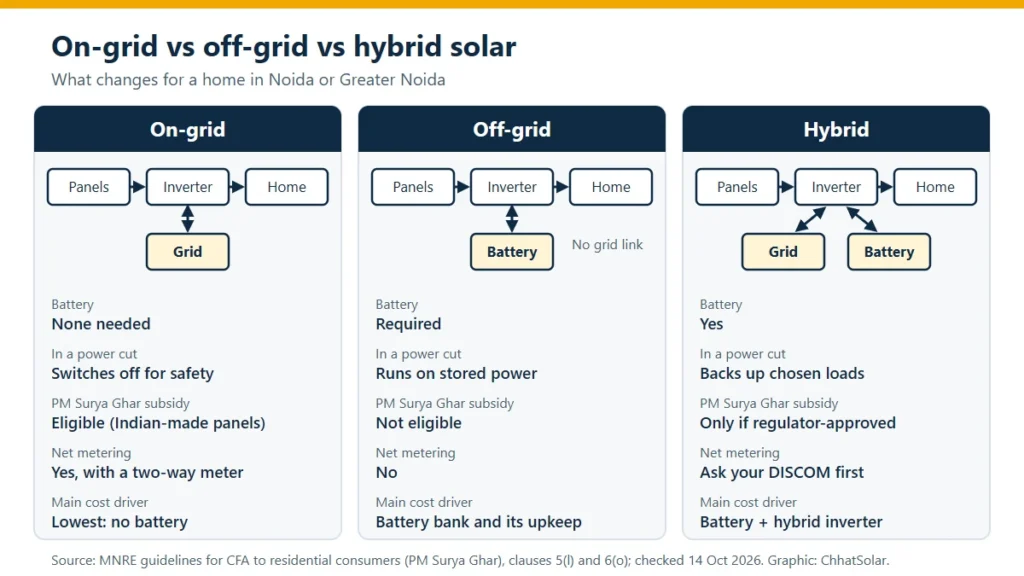
How an on-grid system works
An on-grid (or grid-tied) system has panels, an inverter that turns the panels’ direct current (DC) into the alternating current (AC) your home uses, and a connection to the DISCOM grid through a two-way net meter. During the day your home uses solar power first. Surplus goes to the grid, and at night you draw from it. On your bill, exported units are netted against imported units; our guide to net metering in UP explains the settlement.
Why it switches off in a power cut
MNRE’s technical specifications require grid-connected inverters to switch off quickly when the grid fails. This is called islanding protection. If your inverter kept pushing power into a “dead” line, it could injure a lineman repairing it or damage equipment. So a standard on-grid system gives no backup during an outage, even on a sunny afternoon. If you already have a home inverter with batteries for backup, that is a separate system; ask your solar vendor how the two will be wired.
How an off-grid system works
An off-grid system is not connected to the grid at all. Panels charge a battery bank, and the inverter runs your home from the panels and batteries. It keeps going in a power cut for as long as the batteries last, but it has three drawbacks for a city home:
- No subsidy. MNRE’s guidelines say off-grid installations are not eligible for central financial assistance. In UP, the state subsidy is tied to net metering, so it does not apply either.
- No net metering. Surplus power has nowhere to go once the batteries are full, so it is wasted.
- Battery cost and care. Batteries add to the upfront price and need periodic care and, eventually, replacement. Ask the battery maker for the warranty period and the expected number of charge cycles.
Off-grid makes most sense where there is no grid connection at all.
On grid vs off grid vs hybrid: where hybrids fit
A hybrid system is grid-connected but also has a battery, usually with a hybrid inverter that manages panels, battery and grid together. It can keep selected circuits running during a power cut and still trade power with the grid when it is available.
On subsidy, MNRE’s guidelines treat grid-connected systems that are “behind the meter” or battery hybrids as eligible for CFA only if the state Electricity Regulatory Commission approves the arrangement. The DISCOM then checks the protection equipment during inspection. Even when eligible, the subsidy is calculated only on the panel capacity, so the battery earns nothing extra. We could not confirm how UPERC treats hybrid systems for CFA, so ask your DISCOM in writing before you buy one.
On grid solar system price
For a standard on-grid home system with Indian-made panels, ChhatSolar uses an indicative installed price of ₹50,000 to ₹60,000 per kW, based on MNRE’s benchmark, UPNEDA’s tentative price and a March 2026 trade report. For 3 kW that is ₹1,50,000 to ₹1,80,000 before subsidy, or ₹42,000 to ₹72,000 in UP after the central and state subsidies. The full breakdown is in our 3 kW solar system price guide.
We have not found an authoritative public source for off-grid or hybrid prices, so we do not quote them. What you can say for certain is that both add a battery bank, and off-grid systems give up the subsidy entirely.
Worked example: one Greater Noida home, three choices (illustrative)
An illustrative comparison for a 3 kW system on an NPCL domestic connection. Only the on-grid case is priced, at ₹52,000 per kW (UPNEDA’s tentative figure), because we have no reliable source for off-grid or hybrid prices:
| On-grid | Off-grid | Hybrid | |
|---|---|---|---|
| Panels, inverter, structure | ₹1,56,000 | Vendor quote (off-grid inverter) | Vendor quote (hybrid inverter) |
| Battery bank | None | Extra cost | Extra cost |
| Central subsidy | − ₹78,000 | ₹0 | Up to ₹78,000, only if approved |
| UP state subsidy | − ₹30,000 | ₹0 | Depends on net metering approval |
| Backup in a power cut | No | Yes | Yes, for chosen loads |
Going off-grid gives up as much as ₹1,08,000 of subsidy in UP before you even pay for batteries. For a city home with a grid connection, the usual answer is on-grid, with a separate small backup only if outages are a real problem for you.
Which one should you choose?
- Choose on-grid if you have a reliable grid connection and want the lowest cost and the full subsidy. This fits most homes in Noida and Greater Noida.
- Consider hybrid if frequent or long outages affect essential loads such as medical equipment or work-from-home setups, and you have confirmed with your DISCOM how it will be metered and whether CFA applies.
- Choose off-grid only if there is no grid connection, or you are willing to forgo the subsidy and net metering.
Whichever you pick, upkeep matters; see our solar panel maintenance cost guide. To estimate size and savings for an on-grid system, use the solar cost calculator. Subsidy amounts are explained in our PM Surya Ghar subsidy guide.
Key takeaways
- On-grid systems are the cheapest, get the PM Surya Ghar subsidy and work with net metering, but switch off in a power cut.
- Off-grid systems keep running in an outage but get no central or UP subsidy, and need batteries.
- Hybrids add a battery to a grid-connected system; CFA applies only with regulator approval and only on panel capacity.
- For most Noida and Greater Noida homes, on-grid is the practical choice.
Frequently asked questions
Which is better for a home in Noida, on-grid or off-grid solar?
For most homes with a grid connection, on-grid. It costs less, qualifies for the PM Surya Ghar subsidy (and the UP state subsidy if still available), and lets you use net metering. Off-grid suits places without a grid connection.
Does an on-grid solar system work during a power cut?
No. MNRE’s specifications require grid-connected inverters to switch off when the grid fails, to protect people working on the lines. You need a battery-based hybrid or a separate backup for power during outages.
Is the subsidy available for off-grid solar under PM Surya Ghar?
No. MNRE’s guidelines state that off-grid installations are not eligible for central financial assistance. In UP, the state subsidy also requires net metering, which an off-grid system cannot have.
What is a hybrid solar system?
A grid-connected system with a battery, usually managed by a hybrid inverter. It can back up selected loads during a power cut and use the grid when it is available. CFA applies only where the state regulator approves the arrangement, and only on panel capacity.
Can I add batteries to an on-grid system later?
It depends on your inverter and your DISCOM. Some systems need a hybrid inverter or extra equipment, and a change to the metering arrangement may need DISCOM approval. Ask your vendor and your DISCOM before you buy, and remember the battery adds nothing to the subsidy.
Sources: MNRE guidelines for CFA to residential consumers (clauses 5(l), 6(o) and the technical specification on grid islanding); MNRE rooftop solar FAQ; PM Surya Ghar National Portal. All accessed 14 October 2026.